Fixed vs Variable Rate Mortgages in Spain: What Really Matters?
The real decision is not fixed versus variable in the abstract. It is whether you value payment certainty, flexibility, or a middle road that still feels manageable if rates move against you.
 Written by Alberto Bertazzi
 Reviewed by Mike Brady
Fixed vs Variable Rate Mortgages in Spain: What Really Matters?
The real decision is not fixed versus variable in the abstract. It is whether you value payment certainty, flexibility, or a middle road that still feels manageable if rates move against you.
Alberto BertazziMike Brady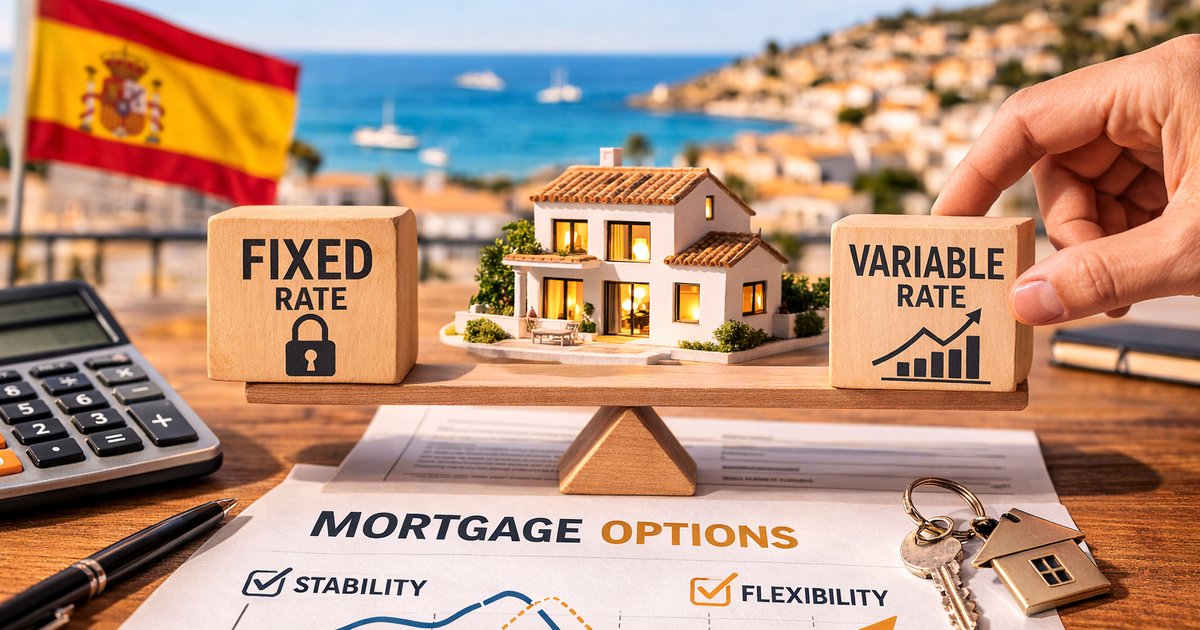
What matters most
- With a fixed rate, your interest rate and monthly instalment stay the same for the life of the loan.
- With a variable rate, the pricing is usually expressed as a benchmark such as 12-month Euribor plus a spread, and the payment is reviewed periodically.
- Mixed-rate mortgages start with a fixed period and then move to variable, which can suit buyers who want early certainty without committing to fixed pricing forever.
What a fixed-rate mortgage gives you
A fixed-rate mortgage is the easy one to explain: the rate stays the same and so does the standard monthly payment. For many buyers, especially those managing a property from abroad, that predictability is the real product. You know what the payment will be, you can stress-test it once, and you do not need to revisit the same question every review period.
The trade-off is that fixed pricing can come in above variable pricing at the start. Whether that premium is worth it depends on your budget discipline, time horizon and appetite for surprises.
How variable mortgages behave
Variable mortgages in Spain are normally linked to a benchmark rate, commonly 12-month Euribor, plus an agreed spread. The rate is then reviewed every six or twelve months depending on the contract. If the benchmark rises, the payment can rise. If it falls, the payment can fall.
For some buyers, that feels acceptable because they expect to hold the property for a shorter period or they want the lower initial cost that variable pricing can sometimes offer. For others, it feels like handing the steering wheel to the weather.
The mixed-rate option
Mixed products are often the compromise. They give you a fixed rate for an initial period and then shift onto a variable structure later. That can work well for buyers who want the early years of ownership to feel calm, but are comfortable with more rate exposure further down the line.
The important point is to model the mortgage as a whole, not just the first attractive number. The first few years can look polished while the long-run cost tells a more complicated story.
How we normally advise clients
We usually start with the client rather than the product. Are you living off salary, drawings or dividend income? Is the property a second home, a relocation base or an investment? Do you want a payment that stays obedient even if the market does not? Those answers matter more than generic internet debates about whether rates will be higher or lower next year.
A bespoke comparison should look at monthly payment, total interest, flexibility, early repayment intentions and what happens if rates move in the wrong direction at the wrong time.
The human side of the choice
Some decisions are mathematical. Others are psychological. A technically acceptable variable mortgage can still be the wrong mortgage if it will make the client uneasy every review cycle. At FCG, we walk clients through the shape of the decision so they understand not only what is available, but what actually suits them.
Ready to see where you stand?
If you want an initial assessment based on your actual income, debts, residency and target property, complete the FCG online application. Start your online mortgage application →